
What Size Rug for a Living Room? Size Chart by Room and Sofa
By the Dream Home Heaven team · Updated November 2026
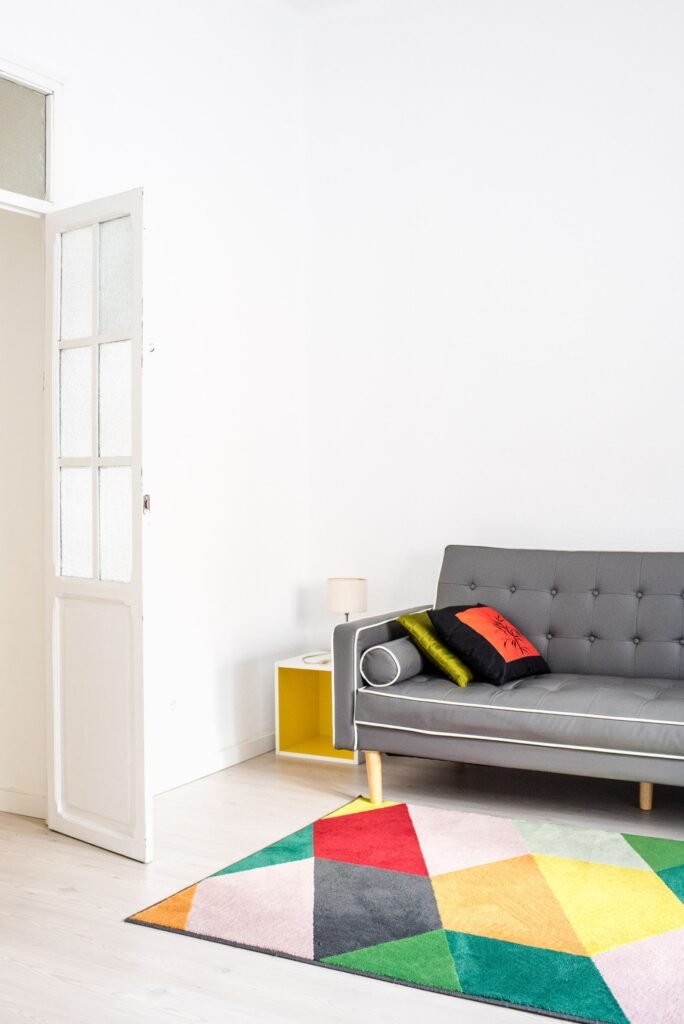
So, what size rug for a living room? For most living rooms it’s an 8×10 or a 9×12. Pick a rug that leaves 12 to 18 inches of bare floor around the edges and is big enough for at least the front legs of your sofa and chairs to sit on it. Small rooms can go 6×9; large or open-plan rooms usually need 10×14 or bigger.
The most common rug mistake designers see is a rug that’s too small, floating in the middle of the room like a postage stamp. It makes the whole space look smaller and the furniture look disconnected. The good news: you can get it right with a tape measure, a simple subtraction and the charts below. We’ll cover sizing by room, by sofa length, three layouts that always work, and a 10-minute tape test before you buy.
📏 Quick Answer: Living Room Rug Sizes
- Small room (under about 11×13 ft): 6×9 or 5×8
- Average room (about 11×13 to 12×15 ft): 8×10
- Large room (12×15 ft and up): 9×12
- Open plan or big sectional: 10×14 or 12×15
- Rule of thumb: rug size = room size minus 2 to 3 feet on each dimension, and wider than your sofa.
In this guide
What Are the Rules for Choosing a Living Room Rug Size?
Three rules cover almost every living room. Leave 12 to 18 inches of floor showing between the rug and the walls. Make the rug big enough that at least the front legs of your main seating sit on it. And when you’re stuck between two sizes, go with the bigger one. Crate & Barrel’s rug guide sums it up as “when in doubt, size up.”
Rule 1: The border rule (12 to 18 inches)
A strip of bare floor around the rug frames it like a mat around a picture. Most rug makers suggest 12 to 18 inches. Ruggable’s size guide gives a little more room in big spaces (up to 36 inches for a 10×14), and Wayfair says anywhere from 5 to 18 inches works on wood or tile. Less than about 6 inches starts to look like wall-to-wall carpet that didn’t fit.
Rule 2: The furniture rule
The rug should connect the furniture, not sit in front of it. At a minimum, the front legs of your sofa and any chairs in the seating group should rest on the rug. If every piece touches the rug, the room feels pulled together.
Rule 3: Size up when in doubt
A slightly big rug makes a room look larger. A slightly small one makes it look cramped and cluttered. If your math lands between an 8×10 and a 9×12, and the 9×12 still leaves at least 12 inches of floor, go big.
What Size Rug Do I Need for My Room Size?
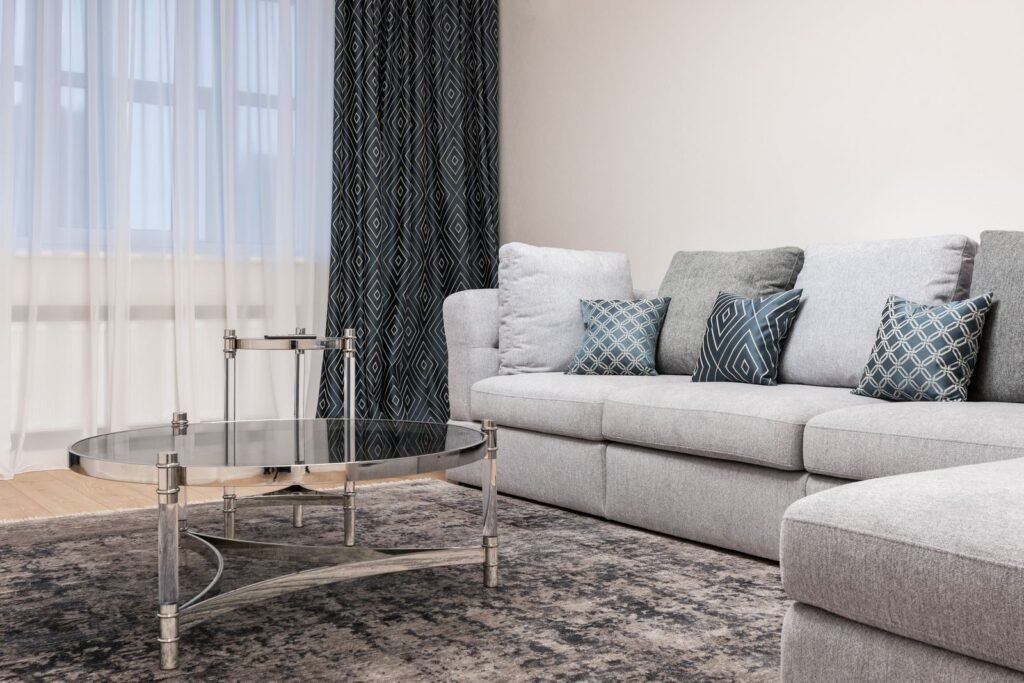
Subtract 2 to 3 feet from each room dimension, then round down to the nearest standard rug size. A 12×15-foot room minus 3 feet each way is 9×12, which is a standard size and leaves 18 inches of floor on every side. Use the chart below as your starting point.
| Room size (feet) | Best rug size | Floor left around rug | Also works |
|---|---|---|---|
| 🏠 9 x 12 | 6×9 | 18 in on each side | 5×8 under coffee table only |
| 🏠 10 x 12 | 8×10 (tight) or 6×9 | 12 in each side with 8×10 | 7×9 if you can find one |
| 🏠 11 x 13 | 8×10 | 18 in each side | 6×9 with front legs off |
| 🏠 12 x 14 | 9×12 | 18 in and 12 in | 8×10 |
| 🏠 12 x 15 | 9×12 | 18 in each side | 8×10 |
| 🏠 13 x 16 | 10×14 | 18 in and 12 in | 9×12 |
| 🏠 14 x 18 | 10×14 or 12×15 | 24 in or 12–18 in | Two rugs for two zones |
| 🏠 15 x 20 and up | 12×15 or 12×18 | 18 in or more | Layered rugs |
Our calculations using standard US rug sizes and the 12-to-18-inch border. Measure your actual room, minus any built-ins or hearths.
Here’s a real example. Jenna’s living room is 11 by 14 feet, with a sofa on the long wall facing a TV. An 8×10 leaves 18 inches on the short sides and 24 inches on the long sides, which looks balanced and lets the sofa’s front legs sit on the rug. A 9×12 would leave just 12 inches at each end, which works too, but it would run under the TV console. She went with the 8×10.
What Size Rug Goes With My Sofa or Sectional?
Your rug should be wider than your sofa. A good target is a rug that extends at least 6 inches past each end of the sofa, so the sofa looks like it sits on the rug rather than beside it. For a 7-foot (84-inch) sofa, that means a rug at least 8 feet wide. Sectionals usually need a 9×12 or larger.
| Sofa or seating | Typical length | Minimum rug | Best rug |
|---|---|---|---|
| 🛋️ Loveseat + 2 chairs | About 5–6 ft | 5×8 | 6×9 |
| 🛋️ Apartment sofa | About 6–7 ft | 6×9 | 8×10 |
| 🛋️ Standard sofa | About 7–7.5 ft | 8×10 | 8×10 or 9×12 |
| 🛋️ Large sofa | About 8 ft and up | 9×12 | 9×12 |
| 🛋️ Sofa + loveseat facing | Two pieces | 9×12 | 10×14 |
| 🛋️ L-shaped sectional | About 9–10 ft per side | 9×12 | 10×14 |
| 🛋️ Large or U-shaped sectional | 10 ft and up | 10×14 | 12×15 or 12×18 |
Sofa lengths are common ranges; measure yours. Sectional guidance matches Crate & Barrel’s size list (9×12 for a sectional, 12×18 for a large one).
With a sectional, place the rug so it reaches under the front legs on both sides of the L. If you have an ottoman instead of a coffee table, center the rug on the ottoman and check the open side of the L still has 12 inches or more of rug in front of it.
Should All Furniture Legs Be on the Rug?
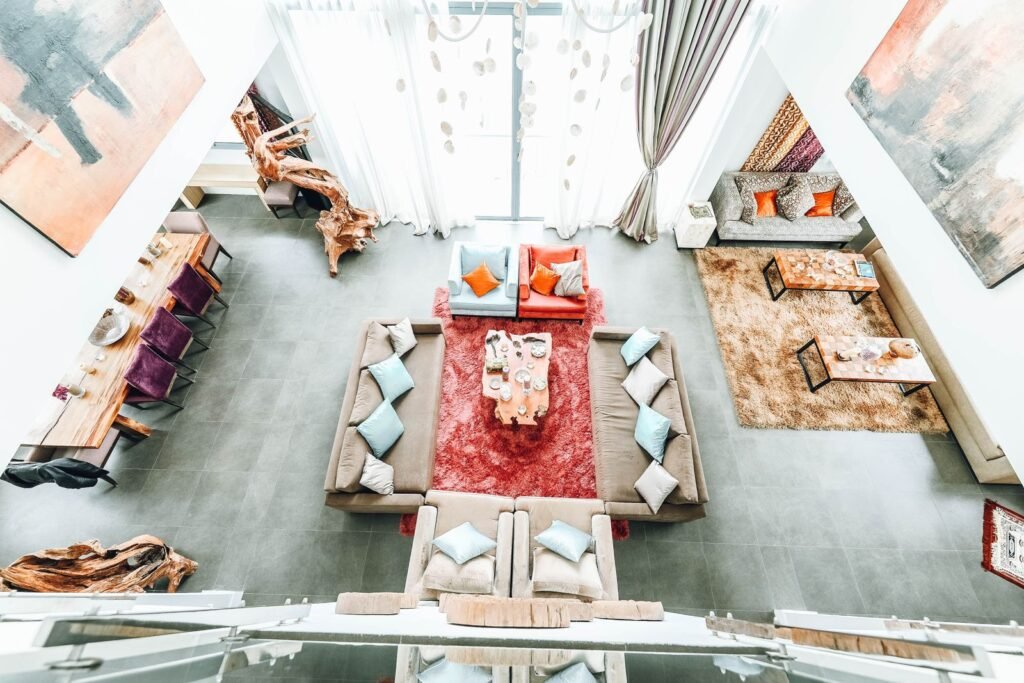
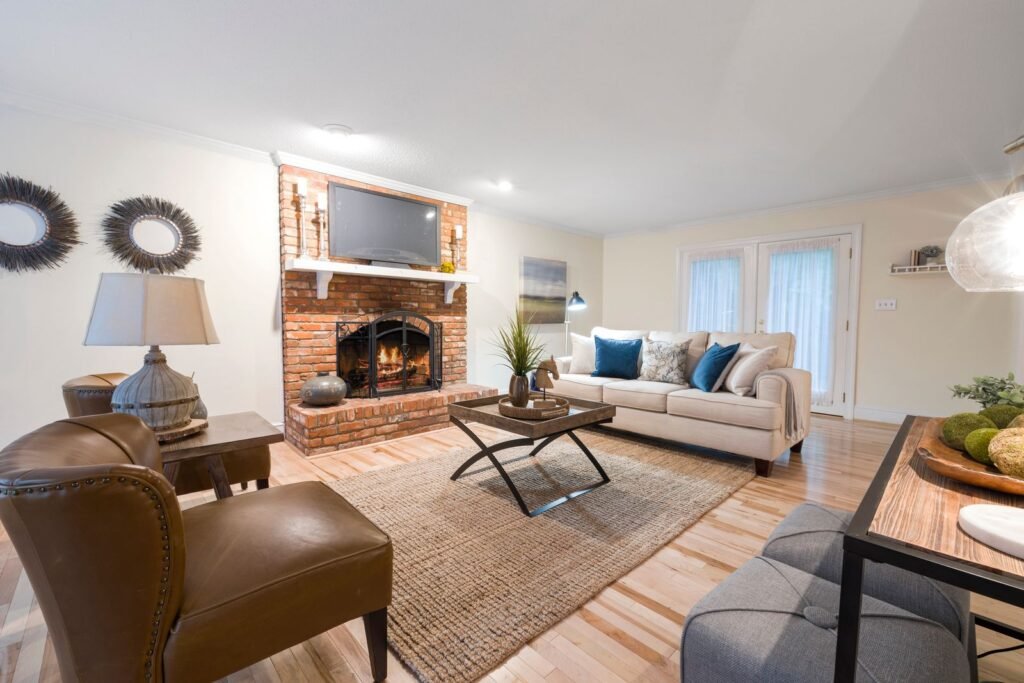
Not necessarily. There are three layouts that work: all legs on the rug, front legs only, or no legs with the rug under the coffee table. All legs looks the most luxurious but needs the biggest rug. Front legs is the most common and works with an 8×10 in most rooms. Floating suits small rooms.
| Layout | What it looks like | Typical rug | Best for | Watch out for |
|---|---|---|---|---|
| ✅ All legs on | Every piece sits fully on the rug | 9×12, 10×14+ | Large rooms, furniture pulled off the walls | Cost; needs a big room |
| 👍 Front legs on | Front legs of sofa and chairs on the rug, back legs on the floor | 8×10, 9×12 | Most living rooms, sofa against a wall | Keep it consistent for every piece |
| 🪶 Floating | Rug under the coffee table only; no furniture legs on it | 5×8, 6×9 | Small rooms and apartments | Too small a rug looks lost |
The key is consistency. If the sofa’s front legs are on the rug, the chairs’ front legs should be too. Home Depot’s rug size guide suggests 6×9 or 8×10 for this “front legs” look when furniture sits against the walls, and 9×12 when furniture floats in the room.
How Do You Measure a Living Room for a Rug?
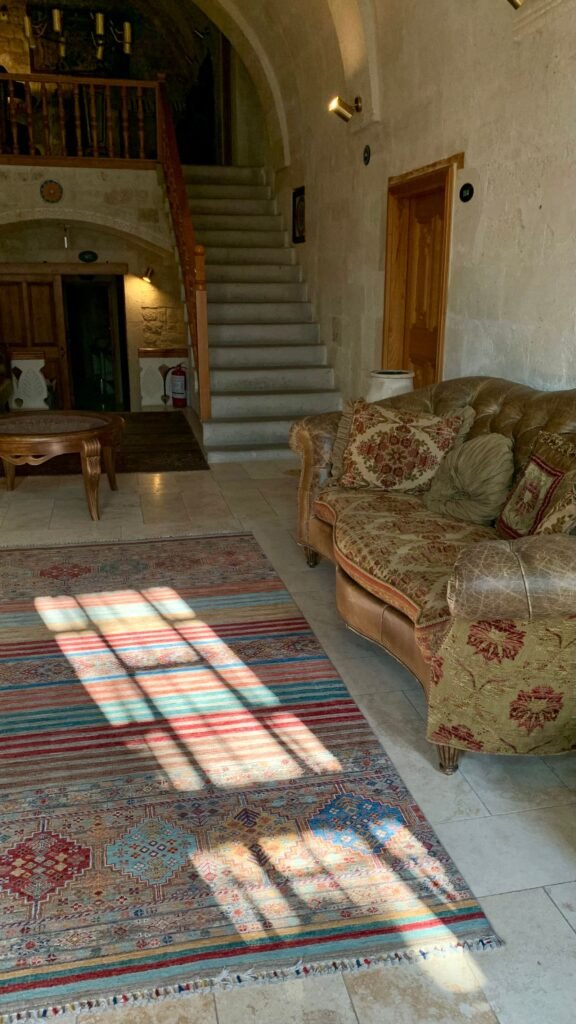
Measure the seating area, not just the room. Then mark the rug’s outline on the floor with painter’s tape and live with it for a day. Wayfair suggests using tape, wrapping paper or even a bed sheet to test the size before you buy. It’s the cheapest way to avoid a return.
- Measure the room wall to wall in both directions. Note doors, vents and fireplace hearths.
- Subtract the border. Take 2 to 3 feet off each dimension (12 to 18 inches per side).
- Measure your sofa. Add at least 12 inches total, so the rug runs past both ends.
- Measure the seating depth. From the back of the sofa to the front legs of the chairs across from it. The rug should reach at least the front legs on both sides.
- Pick the standard size that fits inside the border and covers the seating.
- Tape it out. Mark the exact rug dimensions on the floor and walk around it. Check doors still swing over it.
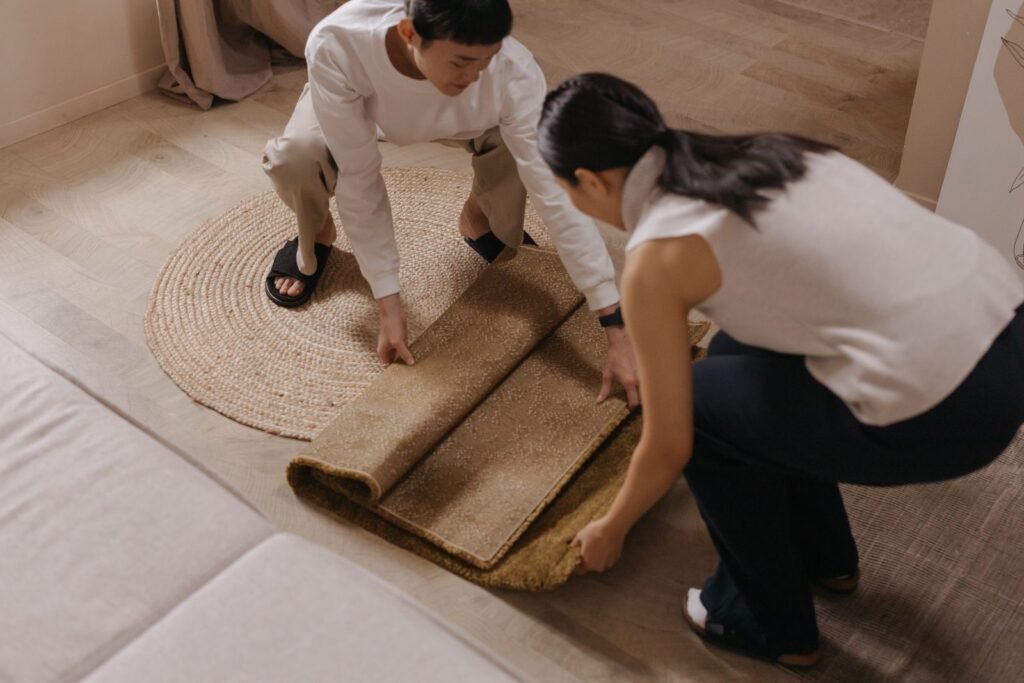
Don’t forget the pad. A rug pad stops slipping and protects your floor. Cut it slightly smaller than the rug, about an inch in from each edge, so it doesn’t peek out. Already dealing with dents from heavy furniture? Our guide on avoiding and fixing furniture marks helps.
What About Small Rooms, Open Plans, Fireplaces and Round Rugs?
Small living rooms and apartments
In a small room, a 5×8 or 6×9 rug under the coffee table, with the sofa’s front legs just touching or not touching at all, keeps a strip of floor visible and makes the room feel bigger. Avoid a 4×6 in front of a full-size sofa; it’ll look like a bath mat. A low-pile rug also makes a small room feel less crowded.
Open-plan living rooms
In an open plan, the rug’s job is to define the living zone. Size it to the furniture group, not the whole space. A 9×12 or 10×14 under the seating, with a separate rug under the dining table, makes two clear rooms out of one big one. Leave a walkway of bare floor between zones.
Living rooms with a fireplace
Keep the rug clear of the hearth and away from sparks. A rug that stops just short of the hearth, centered on the fireplace, looks intentional. Our guide on how far furniture should be from a fireplace has clearance numbers, and 5 fireplace living room layouts show where the rug lands in each.
Round rugs
Round rugs work best under a round coffee table or in a reading corner with one or two chairs. For a full seating group, a rectangle almost always fits better because sofas are straight. If you love the round look, try a 6- to 8-foot round under a round coffee table. Our round coffee table decor ideas show how to style it.

Living Room Rug Mistakes to Avoid
- Buying too small. The number one mistake. If no furniture touches the rug in a medium room, it’s too small.
- Going wall to wall. Less than about 6 inches of floor makes the room look boxed in.
- Centering the rug on the room instead of the furniture. Center it on the seating group.
- Mixing layouts. Sofa legs on, chair legs off looks accidental. Pick one rule.
- Trusting the nominal size. Check exact measurements before buying.
- Blocking doors. A thick rug can catch a door. Tape test first.
- Skipping the pad. Rugs slip, bunch and wear faster without one.

Once your rug is down, keep it looking new. Our guide on cleaning carpet without a machine works for most area rugs too.
Frequently Asked Questions
Is an 8×10 rug big enough for a living room?
For most average living rooms, yes. An 8×10 fits rooms around 11×13 feet with 12 to 18 inches of floor around it, and lets the front legs of a standard sofa and chairs sit on it. Larger rooms or sectionals usually need a 9×12.
What size rug for a 12×12 living room?
An 8×10 is usually best in a 12×12 room. It leaves 24 inches of floor on two sides and 12 inches on the others. A 9×9 square rug, if you can find one, gives an even 18-inch border all around.
Should a rug go under the couch?
At least partly. In most living rooms the sofa’s front legs should sit on the rug, which ties the furniture together. In large rooms, the whole sofa can sit on the rug. In small rooms, a floating rug under the coffee table is fine.
How far should a rug be from the wall?
Leave about 12 to 18 inches of bare floor between the rug and the walls in most living rooms. In very large rooms you can leave up to about 24 to 36 inches. Much less than 6 inches starts to look like wall-to-wall carpet.
Does a bigger rug make a room look bigger?
Usually, yes. A rug that holds the whole seating group makes the space look calm and connected, while a small rug breaks up the floor and can make the room feel smaller. Just keep a visible border of floor around it.
What size rug for a sectional?
Most L-shaped sectionals need at least a 9×12, and a 10×14 often looks better. Very large or U-shaped sectionals may need 12×15 or 12×18. The front legs on both sides of the L should rest on the rug.
The Bottom Line
What size rug for a living room comes down to two measurements: your room minus 12 to 18 inches on each side, and your sofa plus a little extra on each end. For most homes that’s an 8×10 or a 9×12. Tape the outline on the floor before you buy, choose one leg layout and stick with it, and size up when you’re unsure. Your living room will look bigger and more finished for it.
Keep learning: more living room size guides from Dream Home Heaven
- How high to mount a TV on the wall (height chart by size)
- How to arrange a living room with a fireplace
- Christmas tree size guide: height and width by ceiling
Sources: Ruggable Rug Size Guide; Crate & Barrel Rug Guide; Wayfair, How to Choose a Rug Size; The Home Depot, Rug Sizes for Your Space. Size chart calculations by Dream Home Heaven. Updated November 2026.
What size is your living room? Tell us in the comments and we’ll help you pick a rug size.