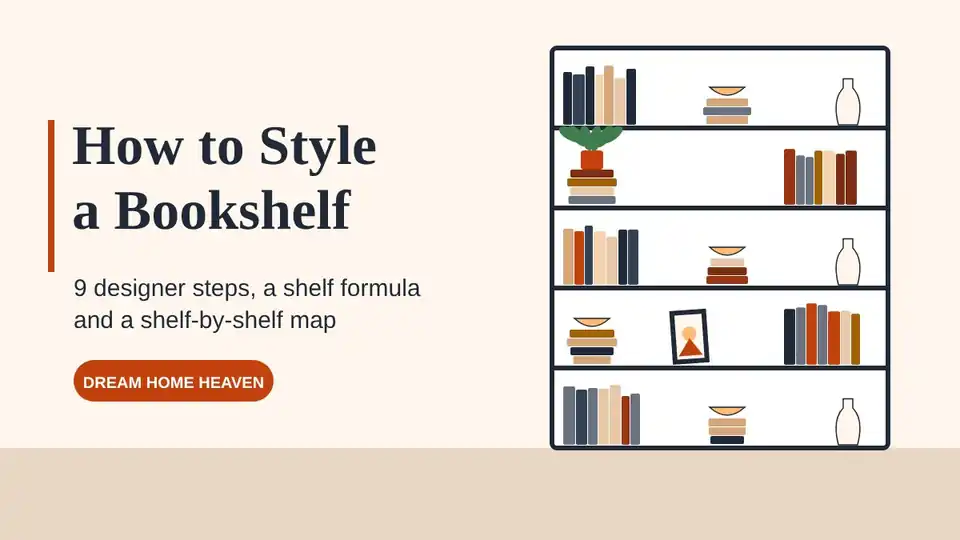
Here’s the short answer on how to style a bookshelf: empty it, put your biggest pieces in first in a zigzag from shelf to shelf, fill in with books grouped upright and in small stacks, then add a few objects in groups of three. Aim for roughly two-thirds books and one-third objects, and leave a little empty space on every shelf.
That’s the formula. The craft is in the details, and that’s what this guide covers: a 9-step method you can finish in an afternoon, a shelf-by-shelf map, tips for built-ins, floating shelves and ladder shelves, and the small mistakes that make a shelf look cluttered no matter how nice your things are.
📚 Quick Answer: How Do You Style a Bookshelf?
- Start empty. Take everything off, dust, and sort into books, art, objects and baskets.
- Big pieces first, placed in a zigzag so no two shelves look the same.
- Mix book directions: upright rows plus short horizontal stacks (3 to 5 books).
- Group objects in threes with one tall, one medium and one short piece.
- Keep the mix: about 2/3 books, 1/3 objects, plus some breathing room.
- Heavy at the bottom, light at the top, and anchor tall bookcases to the wall.
In this guide
How to Style a Bookshelf in 9 Steps
Designers don’t style a shelf in one pass. They build it in layers: structure, then books, then objects, then edits. Follow the steps in order and you’ll avoid the most common trap, which is placing small trinkets first and then running out of room for anything that actually anchors the shelf.
1. Anchor it, then clear it completely
Before anything pretty happens, make the bookcase safe. A loaded bookcase is top-heavy, and kids love to climb shelves. The U.S. Consumer Product Safety Commission estimates that emergency departments treated an average of 17,800 tip-over injuries a year from 2020 to 2022, and it urges families to anchor bookcases and dressers to the wall. Its Anchor It! campaign shows the simple bracket-and-strap method below.
Then take everything off. Yes, everything. It feels like extra work, but you can’t see a shelf’s proportions when it’s full, and you’ll make better choices from a blank canvas. Dust the shelves while they’re empty, too. It’s the one time of year you can reach the back corners.
2. Sort into four piles and edit hard
Group like with like: books, art and frames, objects (vases, bowls, candles, keepsakes) and storage (baskets, boxes). Now be honest. The paperback you’ll never reread, the souvenir you don’t love, the stack of old magazines: those go to a donation box, not back on the shelf. A styled bookshelf is a highlight reel, not an archive.
3. Choose a simple color story
Pick two or three colors that already live in the room, like the throw pillows or the rug, and let those guide your objects. If your living room is cream and terracotta, a rust vase, a cream bowl and a wood bookend will look calm and planned. Want a bolder look? Paint the back of the bookcase a darker shade so everything in front pops. Here’s the catch: dark backs show dust and clutter more, so they reward a lighter hand with objects.
4. Place your biggest pieces first, in a zigzag
Your largest items (a big framed print, a tall vase, a large basket) set the rhythm, so they go in before anything else. Put one on the left of the top shelf, the next on the right of the shelf below, then back to the left. That zigzag pulls the eye across and down the whole bookcase instead of stopping on one heavy spot.
The same trick works for color. If you have three rust-colored objects, don’t line them up on one shelf. Spread them high, middle and low on alternating sides, and the whole bookcase suddenly looks connected.
5. Add books in groups, not wall-to-wall rows
Books are the backbone, so give them variety. Mix upright rows (held by a bookend or a heavy object) with horizontal stacks of three to five books. A stack does double duty: it breaks up the line of spines and becomes a little pedestal for a bowl or candle. Put taller, heavier books low and shorter ones higher, which looks grounded and keeps the weight down where it belongs.
Should you sort books by color? It’s pretty, and it works well for a decor-first shelf in a living room. But if you actually read and reread your books, finding a title by the color of its spine gets old fast. Here’s how the main options compare:
| Arrangement | Looks | Easy to find books? | Best for |
|---|---|---|---|
| 📚 By size (tall to short) | Neat, classic | Medium | Built-ins, formal living rooms |
| 🌈 By color | Bold, calm from a distance | Hard | Decor-first shelves, kids’ rooms |
| 🔤 By author or genre | Busier | Easy | Home offices, real readers |
| 🔄 Spines turned in | Soft, neutral | Very hard | Rarely a good idea (it also stresses spines) |
| ✨ Mixed groups + stacks | Collected, designer look | Easy within each group | Most homes |
6. Layer art and frames
Lean a framed print against the back of a shelf, then set a smaller object or a short stack in front of it. That front-to-back layering adds depth, which is the difference between a shelf that looks styled and one that looks like storage. A mix of portrait and landscape frames keeps things lively. If you like this layered look, you’ll find more ideas in our guide to creative wall decor ideas for the living room.
7. Group objects in threes
Odd numbers feel natural to the eye, and three is the easiest. Pick one tall, one medium and one short piece and arrange them in a loose triangle. Think of a bud vase, a small bowl and a stone paperweight. Keep it to one or two groupings per shelf. When in doubt, use fewer, larger objects instead of many tiny ones, because small trinkets read as clutter from across the room.
8. Bring in something living
A trailing pothos on a top shelf softens all those straight lines. Low light? A good faux plant does the same job with zero watering. Set real plants in a cachepot or on a saucer so a watering mistake doesn’t ruin your books. For plants that do well indoors, see our list of the best indoor plants for clean air.
9. Add light, step back and edit
A small lamp on one shelf or warm LED strips under the shelf edges turn a bookcase into evening mood lighting. Hide cords behind books or along the side panels. Then do the most important step: stand 10 feet back, squint, and look for heavy spots and gaps. Take a phone photo, too. Photos flatten a shelf and make anything off-balance jump out. Most shelves look better after you remove one or two things.
Now that you know the steps, let’s get specific about how much to put on each shelf.
How Much to Put on Each Shelf: The Shelf Mix Formula
Most bookshelf decor ideas stop at “don’t overcrowd it.” That’s true, but not very useful. Here’s the rule of thumb we use: about two-thirds books, about one-third objects, and a little breathing room on every shelf.
Let’s put numbers on it. Say each shelf of your bookcase is 30 inches wide. About 20 inches go to books (one upright row and maybe a short stack), about 7 inches to one grouping of objects, and the last few inches stay open. Over a five-shelf bookcase, that’s roughly five book groups, three or four object groupings and one star piece. That’s it. It sounds sparse on paper, but it’s exactly what makes a styled shelf look relaxed.
| Your collection | Books vs objects | How to style it |
|---|---|---|
| 📖 Big book collection (200+) | About 80% / 20% | Full rows, a few horizontal stacks, one object per shelf as a “pause” |
| ⚖️ Average collection | About 2/3 / 1/3 | The standard formula above |
| 🪴 Few books | About 1/3 / 2/3 | Stacks as risers, art, plants, baskets; let objects lead |
| 📦 Storage-heavy shelf | Books on top, baskets below | Matching baskets on the lowest 1–2 shelves hide toys, cables and paperwork |
Dream Home Heaven rule of thumb. Adjust to how you use the shelf.
Shelf-by-Shelf Map: What Goes Where
Each shelf has a job. Treat the top and bottom as supporting players and save your best piece for eye level, where people actually look.
- Top shelf: keep it light. A small frame, a trailing plant or a few short books. Heavy things up high look top-heavy and are a safety risk.
- Upper middle: a short book row plus one sculptural object, like a vase with an interesting shape.
- Eye level (about 4.5 to 5.5 feet up): your star piece. A favorite print, a ceramic you love, a family heirloom.
- Lower middle: bigger books, coffee table books in horizontal stacks.
- Bottom shelf: the heaviest books and matching baskets or boxes. It’s the perfect spot for things that aren’t pretty but need a home.
Picture a family room bookcase where the kids’ board games used to spill over every shelf. Moving them into three matching baskets on the bottom shelf and styling only the top four shelves made the whole wall look calm in under an hour. If toys are your main problem, our guide on how to organize toys at home has a full system.
How to Style Different Types of Bookshelves
The steps above work everywhere, but the shape of your shelf changes the details. Here’s what to adjust.
| Shelf type | What works | Watch out for |
|---|---|---|
| 🏛️ Built-ins (around a TV or fireplace) | Mirror the two sides loosely (same color story, different objects); a dark back paint | Perfect symmetry looks stiff; keep the TV side lighter |
| 🗄️ Tall freestanding bookcase | The zigzag method; baskets on the bottom shelf | Anchor it to the wall; heavy items low |
| ➖ Floating shelves | Fewer, flatter pieces; short stacks; small leaning art | Weight limits; deep objects hang over the edge |
| 🪜 Ladder shelf | Plants and baskets on the wide bottom rungs, a few books up top | Narrow top rungs tip easily; keep them light |
| 🔲 Cube shelf | Alternate cubes: books, a fabric bin, an object, repeat in a checkerboard | Filling every cube the same way looks like a store display |
| 📐 Corner shelf | One tall plant or lamp to fill the corner, small objects on each tier | Too many tiny things get lost in the angle |
Floating shelves deserve a special note because they’re everywhere in small apartments. They’re usually shallow (often 6 to 10 inches deep), so think in layers of two, not three: one leaning frame, one object in front. In a tiny living room, three floating shelves styled with restraint can do the work of a whole bookcase. Our small apartment storage ideas on a budget show more ways to use wall space well.
What to Put on a Bookshelf Besides Books
Running short on books, or just want more personality? These are the pieces that work hardest on a shelf:
- Vases and vessels in two or three heights, empty or with a single stem.
- Framed art and photos, leaned rather than hung, so you can swap them easily.
- Bowls and trays to corral small things like keys, matches or a few shells.
- Bookends in stone, brass or wood. Heavy objects can double as bookends, too.
- Plants, real or faux, especially trailing ones for top shelves.
- Personal pieces: travel finds, a grandparent’s clock, a child’s clay pot. These are what make a shelf yours.
- Baskets and lidded boxes for everything else.
- Candles and a small lamp for warmth at night. Keep real flames away from books, of course.
A small mirror can also help a dark bookcase by bouncing light around. Our post on ideas for decorating with mirrors covers where reflections help and where they just add glare.
Keep It Looking Good (and Protect Your Books)
A styled shelf needs a little upkeep. Give it a quick dust every week or two with a dry microfiber cloth, and run the vacuum brush along the tops of the books once a month. Keep books out of strong direct sunlight, which fades spines over time, and away from damp exterior walls or radiators. Shelve books upright with similar sizes together so they support each other, and lay very tall or heavy books flat instead of letting them lean. If you have rare or valuable books, the Library of Congress points readers to its book care and storage guidance.
Then keep it fresh. Swap a few objects with the seasons: pinecones and a candle in December, a bowl of lemons or fresh stems in spring. Small changes make an old shelf feel new without restyling the whole thing.
Common Bookshelf Styling Mistakes to Avoid
- Filling every inch. Empty space is what makes the pieces you love stand out.
- Lots of tiny trinkets. From across the room they read as clutter. Go bigger and fewer.
- Every shelf the same. Identical rows look like a store. Vary the direction of books and the side your objects sit on.
- Everything pushed to the front edge. Layer front to back instead.
- Heavy items up high. It looks top-heavy and raises the tip-over risk.
- Skipping the anchor. Especially in homes with young kids.
- Forgetting cords. A visible tangle of chargers undoes all your styling.
✅ Bookshelf Styling Checklist
- ☐ Bookcase anchored to the wall
- ☐ Shelves emptied, dusted and edited
- ☐ 2–3 colors chosen from the room
- ☐ Big pieces placed in a zigzag
- ☐ Books in upright rows and short stacks
- ☐ Objects grouped in threes, 1–2 groups per shelf
- ☐ Heavy items and baskets on the bottom
- ☐ Stepped back, took a photo, removed one thing
Frequently Asked Questions
How do you make a bookshelf look nice?
Start with an empty shelf, place large pieces in a zigzag, then add books in a mix of upright rows and short horizontal stacks. Finish with small groups of three objects and leave some empty space on each shelf. Stand back and remove anything that feels crowded.
What should I put on my bookshelf besides books?
Vases, framed art leaned against the back, bowls, bookends, plants, baskets and a few personal keepsakes. Choose fewer, larger pieces over many small trinkets.
How many decor items should be on a shelf?
One or two groupings per shelf is plenty, usually three objects each. As a rule of thumb, aim for about two-thirds books and one-third objects on a typical shelf.
Should books be arranged by color?
Color-sorted books look calm and bold from a distance, so they work well on decor-first shelves. If you reread your books often, sort by genre or author and use color in your objects instead.
How do you style a bookshelf without it looking cluttered?
Edit first, keep a simple color story, use bigger objects instead of many small ones, hide clutter in matching baskets on the bottom shelf and leave empty space on every shelf.
How do you decorate a bookshelf in a living room?
Pull two or three colors from the room’s pillows or rug, put your favorite piece at eye level, add a small lamp or shelf lighting for evenings and keep the TV side of a built-in lighter so it doesn’t feel heavy.
How to Style a Bookshelf: The Bottom Line
Styling a bookshelf isn’t about buying a cart full of decor. It’s about editing what you have, placing big pieces first, mixing the way books sit and leaving room to breathe. Start with one shelf this weekend: empty it, follow the 9 steps and see how much calmer the whole wall feels.
Once your shelves are done, take the same “less but better” idea to the rest of the room, starting with your coffee table decor.
Keep learning: more home guides from Dream Home Heaven
- 10 creative wall decor ideas for the living room
- Small apartment storage ideas on a budget
- How to make your home office more productive
Sources: U.S. Consumer Product Safety Commission (tip-over injury estimates, 2020–2022, release dated Feb. 5, 2026); CPSC Anchor It! campaign; Library of Congress Ask a Librarian (book care). Styling ratios are Dream Home Heaven rules of thumb. Checked November 2026.
What’s the one object on your bookshelf you’d never part with? Tell us in the comments.