
Here’s how to organize a garage on a budget: empty it, sort everything into five piles, then give each thing a home in a zone close to where you use it. Go vertical with cheap shelves, hooks and a pegboard before you even think about cabinets. Most two-car garages can be reset in one weekend for $100 to $500 if you shop smart and reuse what you already own.
That’s the short version. Below you’ll get the full 7-step plan, a zone map you can copy, three real budgets, the safe way to store paint and gasoline, and the mistakes that send most garages straight back to chaos by spring.
This post contains affiliate links. We may earn a small commission at no extra cost to you. See our disclosure.
🧰 Quick Answer: How to Organize a Garage on a Budget
- Step 1: Pick one goal (park the car, a workshop, or both).
- Step 2: Empty the garage and sort into Keep, Relocate, Sell, Donate and Recycle/Dispose.
- Step 3: Clean the floor and walls while it’s empty.
- Step 4: Plan zones: daily gear near doors, rarely used items up high.
- Step 5: Go vertical: shelves, hooks, pegboard, then overhead racks.
- Step 6: Store chemicals high, locked and in original containers.
- Step 7: Label everything and do a 15-minute reset each month.
In this guide
- What garage organization really costs
- Step 1: Choose your garage goal
- Step 2: Empty and sort into 5 piles
- Step 3: Clean while it’s empty
- Step 4: Plan your garage zones
- Step 5: Cheap storage that goes up, not out
- How to organize tools in a garage
- Step 6: Store chemicals and gas safely
- $100 vs $300 vs $500 garage plans
- Step 7: Keep it organized
- Mistakes to avoid
- FAQ
What Does Garage Organization Cost in 2026?
Doing it yourself costs a fraction of hiring out. HomeAdvisor’s garage organization cost guide puts the average professional job at about $1,335, with most people paying between $511 and $2,175. Professional organizers there usually charge $55 to $75 an hour and book a three to four-hour minimum. Go custom with cabinets and slatwall and Fixr’s garage organizer cost guide lists $2,500 to $5,000.
The good news? The pieces that do the heavy lifting are cheap. Here’s what the basics usually cost, so you can plan before you shop.
| Item | Typical price | Best for | Budget tip |
|---|---|---|---|
| 🗄️ Freestanding shelf unit | $50–$100+ for a basic unit | Bins, paint, supplies | One sturdy unit beats three wobbly ones |
| 🪝 Wall hooks | $1–$25 each | Bikes, ladders, cords, yard tools | Buy a multi-pack |
| 🔩 Pegboard | $20–$300 | Hand tools | Start with one panel above the bench |
| 📦 Storage bins or baskets | $10–$125 | Seasonal and grouped items | Clear bins; reuse sturdy boxes you own |
| ⬆️ Overhead ceiling rack | $75–$400 (prefab) | Holiday decor, camping gear | Add it last, once you know what’s left |
| 🔒 Cabinets | $90 and up | Chemicals, valuables | One locking cabinet, not a full wall |
| 🛠️ Workbench | $150–$1,500 (prefab) | DIY projects | A used table or door on sawhorses works |
Price ranges from HomeAdvisor and Fixr cost guides (checked November 2026). Prices vary by brand, size and where you live.
Here’s the catch: people overspend because they buy storage first and sort second. Then half the new bins hold things they never needed. That’s why the steps below put shopping in step 5, not step 1.
Step 1: Choose Your Garage Goal
Start by deciding what the garage is for, because that decides where everything goes. Is it a place to park two cars? A woodworking shop? A home gym, a laundry spot, or just storage for holiday boxes and bikes? Most garages are a mix, and that’s fine, but one job has to come first.
Picture a family of four with a two-car garage they haven’t parked in since they moved. Their goal is simple: get one car back inside before winter. That one sentence tells them the middle of the floor must stay empty, so everything else has to live on the walls or above the hood. A retired woodworker next door has a different goal, and his bench gets the best wall and the best light.
Step 2: Empty the Garage and Sort Into 5 Piles
The first step to organizing a garage is decluttering, and the fastest way is to take everything out. Pull it all onto the driveway or lawn on a dry day. Seeing your stuff in daylight makes it much easier to be honest about what you use.
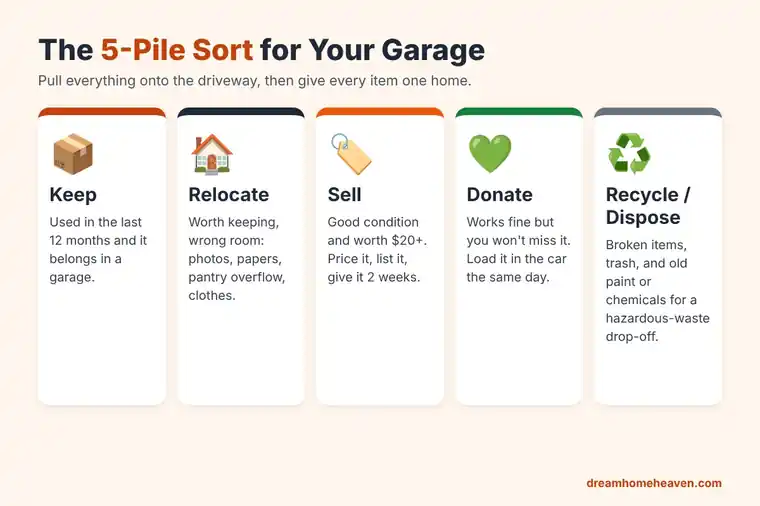
- Keep: you used it in the last 12 months and it belongs in a garage.
- Relocate: worth keeping but in the wrong place, like photo albums, paperwork, pantry overflow or out-of-season clothes. Heat, cold and damp in a garage are hard on these.
- Sell: in good shape and worth about $20 or more. Give it two weeks; if it hasn’t sold, donate it.
- Donate: works fine but you won’t miss it. Load it in the car the same day so it doesn’t creep back in.
- Recycle or dispose: broken items, trash, and leftover paint, pesticides or automotive fluids, which need a household hazardous waste drop-off.
Not sure about something? Ask one question: if this disappeared tonight, would I buy it again? A spare set of cracked flowerpots, no. The good extension ladder, yes. Haven’t used something in over a year and can’t name the next time you will? It’s a strong candidate to go.
Kids’ toys usually make up a big part of the pile. Our guide on how to organize toys at home walks through a toy rotation that keeps outdoor toys from taking over the garage too.
Step 3: Clean the Garage While It’s Empty
An empty garage is the only time cleaning is easy, so don’t skip it. Sweep or blow out the dust and leaves, knock down cobwebs, and scrub oil stains with a degreaser or a paste of cat litter and dish soap. Let the floor dry fully before anything goes back in.
While you’re there, look for leaks, pest droppings or damp corners. Cardboard boxes sitting on a damp floor are where mildew and bugs start, which is another reason to switch to lidded plastic bins on shelves. If you’re in the cleaning mood, our list of things people forget to clean covers the spots inside the house that get missed just as often.
Step 4: Plan Your Garage Zones
Zoning means storing things where you use them. Lawn and garden tools go near the big door, sports gear and kids’ stuff go near the house door, the workshop gets the best light, and anything you touch once or twice a year goes up high. Now that your keep pile is sorted, group it the same way on the driveway before anything goes back in.
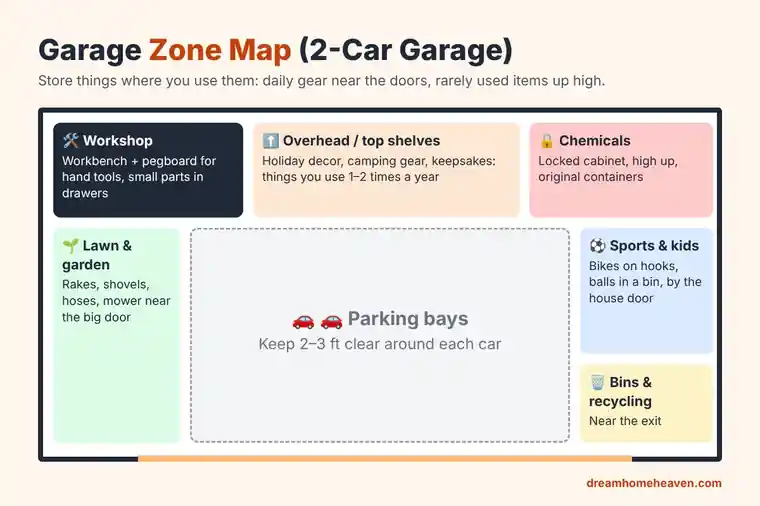
| Zone | What goes there | Where to put it |
|---|---|---|
| 🛠️ Workshop | Hand tools, power tools, hardware | Back wall with good light and outlets |
| 🌱 Lawn and garden | Rakes, shovels, hoses, mower, fertilizer | Next to the main garage door |
| ⚽ Sports and kids | Bikes, balls, scooters, helmets | Near the door into the house |
| 🚗 Car care | Washing supplies, jumper cables, oil | Shelf beside the parking bay |
| ⬆️ Long-term storage | Holiday decor, camping gear, keepsakes | Overhead rack or top shelves |
| 🔒 Chemicals | Paint, pesticides, pool and car chemicals | Locked cabinet, high up, away from heat |
| 🗑️ Bins and recycling | Trash, recycling, donation box | Close to the exit you use on trash day |
Here’s a real-world check. If you have to step over the lawn mower to reach the bikes every school morning, the zones are backwards. Swap them. The best garage layout is the one that matches your daily path, not the one that looks neat in a photo.
Step 5: Cheap Garage Storage That Goes Up, Not Out
Vertical storage is the cheapest way to free up floor space. Walls and ceilings are empty real estate in most garages, and a few shelves, hooks and a pegboard can hold more than a row of expensive cabinets. Shop in this order and stop when your keep pile has a home.
1. Freestanding or wall-mounted shelving
Shelving is the backbone of a budget garage. Metal or heavy plastic units hold bins, paint and supplies, and you can move them later. Check the load rating per shelf before you buy, put heavy things on the bottom, and anchor tall units to the wall studs so they can’t tip.
2. Clear storage bins with lids
Clear bins let you see what’s inside without pulling every box down. Use one size so they stack well, and label the short end that faces you. Heavy-duty, weather-resistant totes are worth it for anything that sits on a cold or damp floor.

- PP5 Plastic
- Imported
- 【Ideal Solutions for Large Storage】If you need to organize closets or other areas throughout the home, Citylife plastic …

- ORGANIZATION: Save room and maximize space with the BLACK & YELLOW 5-Gallon Storage Container. Its the perfect way to or…
- MADE IN THE USA: Choose sustainability with our eco-friendly injection molded storage bins born from American creativity…
- PORTABLE & SECURE: This storage container is designed with robust ergonomic handles for comfort when carrying stored mat…
3. Wall hooks and rails
Hooks are the best dollar-for-dollar buy in any garage. Bikes, ladders, extension cords, garden hoses, folding chairs and long-handled tools all hang up and off the floor. A simple wall rail with movable hooks lets you rearrange as your needs change.
4. Overhead ceiling racks
Overhead racks are perfect for things you use once or twice a year, like holiday decorations, camping gear and keepsakes. Add one last, once you know what’s left. Always check the garage door’s travel path and the rack’s weight limit, and fasten it into ceiling joists, not drywall alone.
5. Repurposed furniture
An old dresser makes a great drawer unit for small parts. Kitchen cabinets from a remodel can become a free lower cabinet run. A storage bench by the house door doubles as a seat for putting on boots. Check local buy-and-sell groups, too; people give away shelving all the time when they move.
Short on space inside the house as well? Many of the same tricks work indoors. Our small apartment storage ideas on a budget show how to use walls, doors and under-bed space for pennies.
How to Organize Tools in a Garage
Tools are easiest to find when you can see them. Hang hand tools on a pegboard above the workbench, keep power tools on a shelf at waist or eye level, and sort small parts like screws and drill bits into labeled drawers or small clear containers.
- Pegboard: mount it over the bench and hang the tools you reach for most in the middle. Trace each tool’s outline with a marker so you’ll know when something’s missing.
- Magnetic strips: great for screwdrivers, wrenches and drill bits. Mount one along the back of the bench.
- Group by job: a painting bin, a plumbing bin and a car-care bin mean you grab one box per project instead of searching.
- Batteries and chargers: give power tool batteries one charging spot on a shelf, away from anything flammable.

- ❤️Metal Pegboard – Our metal pegboard panels are stronger than traditional peg boards, each small pegboard can load-bear…
- ❤️Easy to Install -We offer 30pcs screw and expansion tube mounting kits, the screws and expansion tubes have been upgra…
- ❤️Wide Application:The peg board wall aren’t just for workshops and craft rooms.You can customize the layout to meet you…

- EXCEPTIONAL DURABILITY – Boasting of high-quality alloy steel construction, this Magnetic Tool Holder Storage Organizer …
- EASY INSTALLATION – This wall-mounted tool organizer comes with all the necessary accessories, including mounting screws…
- POWERFUL ORGANIZATION – Say goodbye to messy tool boxes and welcome streamlined organization with this Magnetic Tool Hol…

- Magnetic Tool Organizer: Use this tool organizer to help you get rid of your messy tool box and easily organize your wre…
- Sturdy: The tool organizer is made of high quality alloy steel for sturdiness and durability. Powerful magnets provide s…
- Easy to Install: Magnetic tool holders come with mounting screws to mount the tool holder on the wall in your garage, wo…
Think about the weekend fixer who owns three tape measures because he could never find the first two. Once every tape measure has one hook on the pegboard, the “where is it?” hunt ends, and so does the extra spending.
Step 6: Store Chemicals and Gasoline Safely
Garages hold some of the most dangerous products in a home, so storage here is about safety, not just looks. The EPA’s household hazardous waste guidance says to keep products in their original containers, never remove the labels, never store them in food containers, and never mix leftovers, because some products can react, ignite or explode. It also notes these products can be a hazard to children and pets.
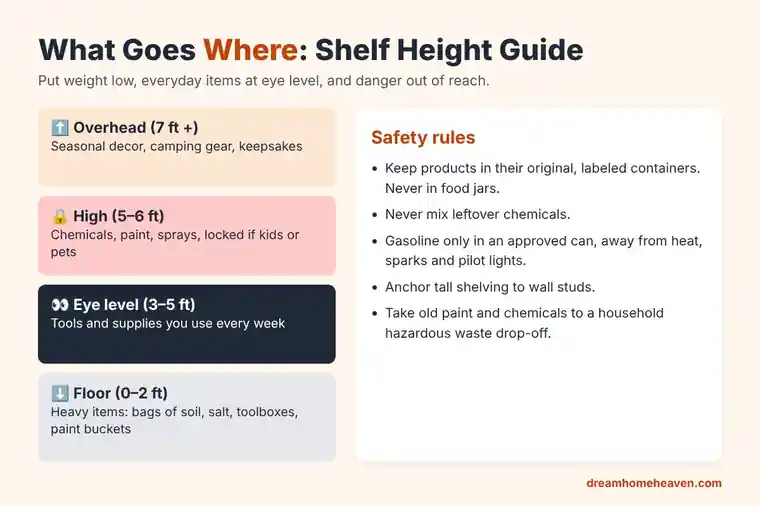
Gasoline needs extra care. Massachusetts’ fire safety guidance on gasoline says to use an approved container, keep it away from heat, sparks, flames and pilot lights, store it in a secure place away from living areas, and keep it away from children. The National Park Service fire prevention bulletin on gas cans adds two easy rules: fill a can only about 95 percent full, and don’t leave a gas can sitting in your vehicle.
- Chemicals in original, labeled containers on a high shelf or in a locked cabinet.
- Never mix leftover chemicals or pour them into other bottles.
- Gasoline only in an approved can, away from the water heater, furnace or any pilot light.
- Heavy items low; tall shelving anchored to the wall.
- Keep a clear path to the doors and to the electrical panel.
- Take old paint, pesticides and fluids to a local household hazardous waste collection.
Got a toddler or a curious dog? Put a child-safety latch on the chemical cabinet even if it’s up high. Kids climb, and shelves make great ladders.
Garage Organization on a Budget: $100 vs $300 vs $500 Plans
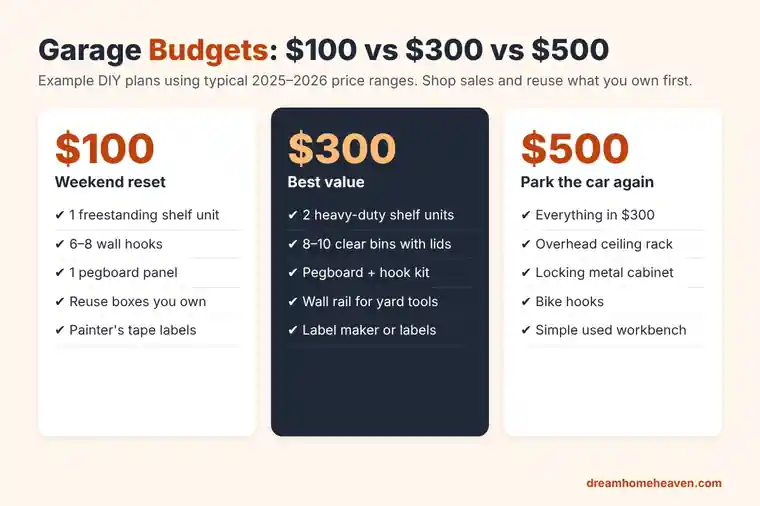
Now that you know what each piece costs, here’s how the money usually stretches. These are example plans built from the price ranges above, not fixed price lists. Shop sales, check secondhand groups and reuse sturdy boxes and furniture you already have.
| Budget | What to buy | Result | Best for |
|---|---|---|---|
| 💵 About $100 | 1 basic shelf unit, 6–8 wall hooks, 1 pegboard panel, painter’s tape for labels | Floor mostly clear, tools visible | Small garages, renters, first reset |
| 💵💵 About $300 | 2 heavy-duty shelf units, 8–10 clear bins, pegboard plus hooks, a wall rail for yard tools, labels | Every item has a home | Most families with a 2-car garage |
| 💵💵💵 About $500 | Everything in $300, plus an overhead rack, a locking cabinet, bike hooks and a used workbench | Car parked inside again, safe chemical storage | Busy households, DIYers |
Example DIY plans based on HomeAdvisor and Fixr price ranges, checked November 2026. Your total depends on brands, sizes and local prices.
Here’s how that plays out. A couple with a cluttered 2-car garage spends Saturday sorting and drops off three carloads at the donation center. On Sunday they put up two shelf units, a pegboard over the old kitchen table they now use as a bench, and a rail for rakes and the hose. They land around $300, and the car goes back inside that night. The overhead rack can wait until after the holidays.
Step 7: Label Everything and Keep It Organized
Labels and a small routine keep a garage organized long after the weekend is over. Label every bin and shelf so everyone in the house knows where things go back. Then set three simple habits.
- One in, one out: a new tool or toy comes in, an old one goes to the donate box.
- Monthly 15-minute reset: put strays back in their zones and empty the donate box.
- Seasonal swap, twice a year: in spring, bring down the garden gear and put the snow shovels up; in fall, do the reverse. It’s also the right time to check whether you still need everything.
The same “a home for everything” idea works in every room. If your closets need the same treatment, see our guide on how to organize clothes for a neat closet, and for the kitchen, these kitchen counter organization ideas.
Garage Organization Mistakes to Avoid
- Buying storage before you declutter. You’ll buy bins for things you’re about to give away.
- Storing heavy things up high. Heavy boxes on top shelves are hard to lift and can fall. Keep weight low.
- Cardboard on the floor. It soaks up moisture and invites bugs. Use lidded plastic bins on shelves.
- Keeping things that don’t like garages. Photos, important papers, electronics and some foods suffer in heat, cold and damp. Relocate them indoors.
- Blocking doors and the electrical panel. Leave clear paths, especially near the door into the house.
- Gas cans next to the water heater. Keep fuel away from any flame, pilot light or spark.
✅ Weekend Garage Checklist
- ☐ I picked one main goal for the garage
- ☐ Everything came out and went into 5 piles
- ☐ Donations are in the car; sell items are listed
- ☐ Floor swept and stains treated
- ☐ Zones marked with painter’s tape
- ☐ Shelves anchored, heavy items low
- ☐ Chemicals high, locked and in original containers
- ☐ Every bin and shelf labeled
Frequently Asked Questions
Can I organize a garage for under $500?
Yes. Most two-car garages can be organized for $100 to $500 if you declutter first, sell what you don’t need, and stick to shelves, hooks, a pegboard and clear bins. Save cabinets and overhead racks for last.
What is the first step in organizing a garage?
Decide what the garage is for, then empty it completely and sort everything into keep, relocate, sell, donate and recycle or dispose piles. Only the keep pile goes back in.
How do I decide what to keep and what to get rid of?
Keep what you’ve used in the last year and would buy again if it disappeared. If you haven’t used it in over a year and can’t name the next time you will, sell it, donate it or dispose of it safely.
What is the best storage for a small garage?
Vertical storage. Use wall-mounted shelves, hooks, a pegboard and an overhead rack to keep the floor clear, and choose multi-use pieces like a storage bench or a fold-down workbench.
How often should I reorganize my garage?
Do a quick 15-minute reset once a month and a bigger check twice a year when you swap seasonal gear. That’s usually enough to stop clutter from building up again.
Are DIY garage storage solutions strong enough for heavy tools?
Yes, if you choose shelving with a load rating that matches what you’ll store, anchor tall units and wall shelves into studs, and keep the heaviest items on the bottom shelves.
How to Organize a Garage on a Budget: The Bottom Line
Organizing a garage on a budget comes down to order, not money. Pick your goal, empty everything, sort it into five piles, and only then buy the few shelves, hooks and bins you need. Put things in zones near where you use them, keep heavy items low and chemicals high and locked, and give it 15 minutes a month.
Start this weekend with just step 2. Once the driveway is full and the donation pile is in the car, the rest goes faster than you’d think.
Keep learning: more home organization guides from Dream Home Heaven
- How to organize toys at home: 9 steps that actually stick
- Small apartment storage ideas on a budget
- Small front porch ideas on a budget: 21 cheap, easy updates
Sources: U.S. EPA, Household Hazardous Waste; Mass.gov, Gasoline Safety; National Park Service, Fire Prevention 52: Gas Cans; HomeAdvisor, Garage Organization Cost; Fixr, Garage Organizer System Cost. Checked November 2026.
What’s the one thing taking over your garage right now: bikes, tools or holiday boxes? Tell us in the comments and we’ll help you find it a home.


Pingback: Easiest Way to Clean a Dishwasher: Best Reviewed